Archive for the ‘SEO Copywriting’ Category

Don’t Be An SEO Black Hat


Are you being tempted by the dark side?

Are you looking for great results without the hard work?

If you are, you are heading for a very big fall because the grass most certainly isn’t greener on the dark side.

As an online marketer, search engine optimisation is vital for your survival. But the only effective way to boost your visibility is through an effective, white hat SEO strategy.

It’s not a quick fix, it’s a long term solution that needs constant nurturing. So if that sounds like too much like hard work to you, perhaps you’d better rethink your online marketing  career.

Creating a winning SEO strategy

If you’re hoping that I’m now going to say I was just kidding and you can achieve great rankings really easily – you’re going to be disappointed.

To be an SEO winner you’ll need the following on your shopping list:

  • Well researched keywords
  • A professionally designed website by someone who understands SEO
  • A professional SEO copywriter to create reader-friendly copy
  • A link building strategy

SEO is a slow burner – overnight results are unlikely (but not impossible, that depends on the competitiveness of your keywords) but if you keep at it and maintain your strategy’s momentum, you’ll get long lasting organic results.

And organic results means no hefty pay per click bill every month.

Creating a losing SEO strategy

If all of that seems like hard work to you, there are some techniques you can adopt to cut corners.

Of course, if you do that you will also encounter the wrath of Google which is never nice. Plus, your website will probably look shocking, read abysmally and will never convert a visitor in a month of Sundays.

Those lovely people at SEOmoz have produced a list of 32 SEO tactics to avoid. These are all black hat techniques which must be avoided at all costs.

Grab yourself a coffee and have a read through them and make sure your strategy is above board and whiter than white.

Some of the comments are really interesting too.

Over to you

What has been your most successful SEO strategy?

Please leave a comment and share your experiences.

Google Instant Preview

The SEO Low Down

Google is constantly changing. It loves to keep internet marketers on their toes by changing the goal posts every so often.

One of the most recent changes that you’re bound to have noticed is the introduction of Google Instant Preview.

Now, when you enter a search term in the Google search box, each of your results will have a little magnifying glass next to it. Designed to help you search smarter, by clicking on the magnifying glass you bring up a preview of the web site so you can see in an instant whether it’s going to be of interest to you. Google instant preview

So now, rather than having to open a site, scan it, realise it’s not for you, hit the back browser and start all over again – you can scan the results without leaving the page to find the website that’s going to offer you what you’re looking for.

How does that effect SEO?

Well, to be honest, no one is really sure at the moment. But what it does mean is that you have to be sure your website is maximised to attract the click-through. Basically you have to make sure that the preview gives them the information they need to choose you.

Here are a few things you can do to tip the balance in your favour:

Say farewell to flash

As you know, flash is not good for SEO because the search engine spiders have a tough time crawling it and are unable to distinguish between normal text and the more prominent heading text (i.e. H1, H2 tags etc.)

An added complication now arises with the arrival of Google Instant Preview because the Preview can’t render the flash element of your website leaving it looking rather distorted and unattractive.

Basically if you want your website to shine, ditch the flash.

META Descriptions

You already know that your META Description doesn’t have a direct effect on your SEO as far as ranking position goes. But it comes into its own when it comes to attracting click-throughs.

The 150-160 characters must convince the searcher that your website is worth checking out because it offers the information they need to know. If you want your magnifying glass to be clicked make sure your META Description tells them what they need to know by including your keywords.

Headings

The size of the preview means the reader isn’t going to be able to make out all the text on your website. That’s why it’s imperative that you use good, descriptive headings within your site that contain your keywords.

By acting as sign posts, they will show the reader what information is available on your web page so their decision to click will be based on what they can see – your headings, layout and images.

Images and Alt tags

Using the right images can make your website. They should be relevant and interesting enough to lure your reader in. Also, to give your SEO as much of a boost as possible, you must also ensure you utilise their Alt tags and filenames making them descriptive, relevant and contain your keywords.

It doesn’t matter what line of business you’re in - a copywriter, electrician, solicitor or builder – these 4 techniques will help boost the attractiveness of your website.

In the ways of the web, looks and substance are both needed if you want to attract traffic. Remember the preview shows only a reduced scale version of your website so you’ll needs as many visual cues as possible to get the click.

Article Marketing–Quantity or Quality?


articlesIf you’re into search engine optimisation the chances are you’re also a keen article marketer as it’s one of the most effective ways of boosting your web presence.

Not only will it help you ‘own more of the web’, it will also position yourself as an expert in your field and generate those all important back links to your website.

But your article marketing will only be effective it if is quality content that you’re putting out. It must be:

  • Well written
  • Written to addresses the needs of your readers
  • Something that gives value

In a rush to produce shed loads of links, some companies become hung up on quantity rather than quality. They’d rather spend only a few pounds per article (these are written by writers who are frequently based abroad and for whom English is not their first language) than pay a decent fee and hire a professional copywriter.

It shouldn’t be a numbers game

It’s true that you need a lot of articles to build links but it’s better practice to submit quality, well written articles over a period of time than bulk submitting sub-standard ones.

Putting a considered, well researched and well written article together isn’t about scanning the internet and cutting and pasting bits from other articles. A copywriter will take the time to discover:

  • What topic is to be discussed
  • The focus of the discussion
  • Who your audience is
  • What they are looking for
  • What tone should be used
  • What do you want to achieve with the article

It’s your reputation at the end of the day

If you are entering into the article marketing world, what you submit and its quality are very important.

You’re putting your name to it; you’re using them as a way of establishing yourself as an expert. Sub standard articles will just make you look foolish.

Remember that your articles aren’t just about link building—people are actually going to read them. Can you really afford to be that careless with your brand?

You get what you pay for

As with all things in life, you get what you pay for so if you want quality you’re going to have to pay for it.

If you are more interested in your reputation, traffic and quality you’ll pay for it.

You’ll want to get the most from your marketing budget, but just make sure you also think about your reputation.

How Not to Design a Website


XWhether you’ve got a website and need a revamp or you’re just starting out on  the web there are certain things you need to avoid when thinking about your design.

Remember that your website is, in effect, your online shop window. Think about how it will be viewed by your visitors, what they will want to see and what they’ll need to know.

Don’t be complicated

If a visitor lands on your website they will want to be able to find out what they need to know quickly and easily.

If they’re faced with numerous options, confusing navigation and a ‘busy’ Home page they are more than likely going to wander off and find another less complicated site. 

Although you need links within your text to aid navigation, don’t over do it. There’s nothing more off putting than text littered with links and – more to the point – vast quantities of boxes in the sidebar containing links and asking them to do umpteen things.

Make your navigation simple and logical.

Flash

At one time Google couldn’t read flash and so it was pretty useless when it came to SEO. Now, the search engine spiders can crawl through it but it still has limited effectiveness when it comes to search engine optimisation.

If you can live without it do, if you can’t keep it to an absolute minimum.

Pretty pictures

Pictures are great but can be over done.
Use them to enhance your text or show your products off. But make sure they are great images, bad ones can kill a website.

And don’t forget that images can also help you with your SEO.

How fast?

Long loading times are a killer. No one wants to hang around while your site loads, even if it does have a little count down graphic.

Google likes sites that load quickly as this post from the Google Official Webmaster Central Blog shows.

The offer

Your website is there to sell so you must have a call to action and an offer.

Some people get so wrapped up in SEO and the look of their site they completely miss it’s main purpose – it’s a sales tool. Without an offer and a clear call to action your website will be completely ineffective.

Of course, along with a new design, fresh content is always a good idea so hiring a good SEO copywriter is always a great investment

How Not to Link Build


linkYou’ve done your keyword research, you’ve designed your website so it’s easy for your readers to navigate, you’ve even found an SEO copywriter to write some great, targeted copy that your visitors will want to read. So what’s next?

That is just the start of your search engine optimisation strategy, if you want it to continue to work and bring in great rankings you’re going to have to become an active link builder.

How do links help?

Let’s go back to the beginning. Every web page is given a Page Rank (a number ranging from 0 to 10 to illustrate your page’s value with 0 being the lowest).

When another page links to you (using a follow link), a little bit of that Page Rank filters through to you (link juice) because it’s seen as a vote of confidence in your page. So the more quality links you get to your website, the higher your Page Rank and the more authoritative you are seen by the search engines.

So how do you get links?

First off, gathering links can a slow and lengthy process (and a continuous one). The best way by far to link build is by doing it organically.

How do you do that? Well it’s by:

  • Writing interesting content that people will want to link to
  • Submitting your website to directories
  • Blogging and linking back to your website through your posts
  • Article marketing

It’s time consuming and slow, but you won’t get Google’s back up.

Is there a quicker way?

Yes there is but I wouldn’t recommend it. Short cuts are never a good idea so don’t buy in links you could be asking for all sorts of trouble especially as you’ll be going against Google’s guidelines and could risk your website. If you don’t believe me take a look at Julie Joyce’s post on Search Engine Journal entitled 4 Huge Mistakes to Avoid When You Build Links“.

If you’re serious about SEO, your website and your reputation, go organic – it’s the only way.

Keywords and Press Releases


Most people see press releases as off line marketing tools. But that doesn’t mean you should lose sight of the fact that they can also be published on online press release websites.

The main advantage of that is that where printed press releases appear for just one day and then become someone’s chip wrappings the next, online press releases will be attracting a new audience for months or even years after its original release date.

That’s why you should always write your press release to include your main keywords so it will continue to attract the audience you want. Although it is important you still follow the usual rules of press release writing.

The usual rules apply

Your press release should still:

  • Be regarded as newsworthy rather than a thinly veiled advert
  • Be brief and too the point. Any waffle will get it rejected immediately
  • Contain quotes from real people and referenced back to them
  • Ensure the first paragraph  summaries your story
  • Make sure you send it to a targeted group of editors rather than going for blanket coverage

The on line press release

Keywords for press releases are just as  important as for your website copy. If you are unsure about how to go about it hire a freelance copywriter to help you.

Using keywords within the copy will make sure your press release is constantly picked up by your target audience for as long as it remains on the internet. The key things to remember are:

  • Focus on your primary keyword for the headline, quotes and opening paragraph but taking care not to over stuff your content
  • Make sure your summary also contains your keyword
  • Still keep your press release brief and to the point
  • Do your research and make sure you send it to journalists and bloggers who will be interested in your  subject

Following these simple tips will help your press release generate new readers and traffic for you for a long time to come. So, if you don’t already do it, start getting your press releases online and enjoy the benefits of longevity and constant traffic.

Building Links For SEO


linkSearch engine optimisation – three words that can fill any internet marketer with dread.

If you opt for the PPC (pay per click) route, you may see faster results but you’ll also experience the high price tag that tends to come with it. SEO may be slower but it’s a more economical long term solution.

To get an SEO strategy that works, you’ll need 3 things:

  • An SEO friendly website that is easy to navigate (for the reader and search engine spiders)
  • Great content written by a professional SEO Copywriter
  • Back links

Yes, I know what you’re thinking but it really will pay to get experts in to help you with the first two on the list.

Many business think they can generate their own copy. But there is a real art to writing to sell on the web and writing something that is going to help with your SEO. I am an SEO copywriter and therefore you probably think I’m just trying to scare you into hiring me (or someone like me) but I’m not. Ask your web designer’s advice and he/she will tell you exactly the same thing.

To get a website that works, converts and ranks you must have all three elements listed above.

So what about backlinks?

When it comes to building backlinks, you must think long term.

There are companies out there who will help you buy links but that often causes more harm than good. The best option is to do it yourself – it takes time and you may need to have a couple of people working on it for you, but it’s by far the best way to go.

I stumbled across this post on Seomoz.org which gives an example of how this can work. Take a look at Rob Ouseby’s post “Create A Link Building Team Within Your Organisation” and see what tips you can pick up to make your whole organisation a continuous link building machine.

Remember a good SEO strategy is on going and involves a well structured website, professional SEO copywriting and continuous backlink building.

Make Your Web Writing Interesting


grub

Once upon a time if you wanted to research a subject you had to go to the library and scour numerous reference books for the information you needed.

Today, you just have to Google it.

So how long will it be before the humble books is consigned to the history web pages of the internet?

With the arrival of the Kindle reader (iPad and smartphones) the traditional book looks to be under threat of extinction. This ‘electronic-paper’ wonder  is supposed to offer a reading experience that looks and reads like real paper.

Really?

Not for me thanks. When I read I like to hold a book; fold back the cover and turn proper pages. I love the way its spine creases, the smell of its pages, the way you can insert your bookmark (only to lose it and then have to spend hours trying to find the page you were on).

Even though they take up vast amounts of space in your luggage, there is something very special about a book – for a start it’s battery is never going to go flat.

Reading on the web

If the text of a book is fairly small, you’ll still read it. If the text on a web page is tiny you won’t bother.

Writing for the web is very different from writing for printed media. Reading from a screen is difficult, tiring and really quite boring. So how do you overcome that to encourage people to read your website?

Make your writing look interesting

If you want people to read your content you have to make it look attractive and the best way to do that is to ensure there is:

  • Lots of white space
  • Headings and sub headings
  • Short paragraphs
  • Bulleted lists

Basically, if you want people to read the content on your website you have to make it look inviting. Your copy has to be interesting, relevant and search engine friendly. Getting the right amount of content on your page is vital – but good SEO Copywriting doesn’t necessarily mean writing thousands and thousands of words.

So how many words should you have per page? There is no right or wrong answer to that, just make sure you use as many words as you need without waffling. So long as your content is interesting, relevant and attractive, people will read it.

Get To Grips With On Page SEO


grip

Every business with a website is after good Google rankings.

With more and more people turning to the internet for goods and services, you’ve got to be listed if you want to be found. Which means your listing has to be on the front page.

The copy on your website has to contribute to getting great rankings and it has to be interesting and relevant to your reader. That’s a tough combination to achieve which is why it is vital your business invests in the services of a good SEO Copywriter who really knows what they are doing.

SEO Cheatsheet

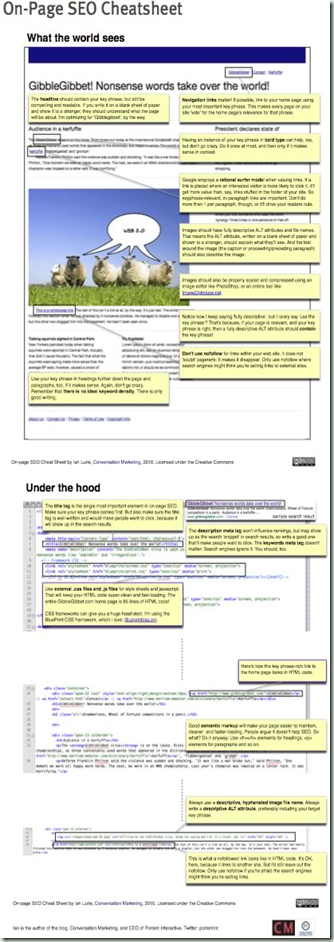
If you are still determined to do your website copy in-house, you’re going to need some help. Luckily I stumbled across a post on Conversion Marketing which will help you out no end.

If it’s your job to manage what appears on your website (images, articles, web copy etc.), this post is for you. If you’re not email the link to this for the person who does – they’ll thank you forever.

Conversion Marketing have put together a great On Page SEO Cheatsheet. It tells you how to get the most from your website’s on page search engine optimisation elements:

image

You can get your very own copy by clicking here and downloading the PDF.

Now you can discover how web pages work in the SEO arena and help optimise your own to give your Google rankings a boost.

How to Make Your Website Convert


coinflipIs your website converting?

There are loads of websites out there that look great, have loads of content and, sometimes, rank quite well. But they are missing one thing – they aren’t converting.

This is a conversation I tend to have with people far too regularly. It goes a bit like this:

Client: “My website’s working really well – I get about 500 unique visitors every day”

Copywriter: “Great, so what’s your conversion rate?”

Client: “My what?”

Argh! There you have it – they’ve missed the number one reason for having a website – converting your visitors into paying customers.

That’s why I’ve written this post – to show you how you can make your website convert visitors.

How to make your website convert

Let’s look at how people behave online.

Imagine you’re looking for a new camera. First you’ll probably enter your search phrase in Google, browse down the results and open a new tab for each entry that catches your eye.

Then you’ll read through each one in turn to see what the companies are offering and gradually whittle the open tabs down until you arrive at the one you want.

Have you worked out how to get your website to convert yet?

Yup – someone will buy from you if you are offering something that no one else is. It could be a price choice, free delivery, extended guarantee…the possibilities are endless.

So if you want to convert your visitors you must identify your unique value proposition and make sure it’s the first thing your potential customers see.

Because your UVP is your primary benefit it has to be something that makes you stand out from the crowd. It could be a free bonus item, price reduction, guarantee – something that is of real value to your reader.

If you hide it within your text or deep inside your site, your reader isn’t going to find it and they’ll go elsewhere. So you have to make their lives as easy as possible and make it obvious and on all pages – after all it might not be your home page they land on.

Have a look at your website – is your UVP obvious? If not you know what you’ve got to do if you want to give your conversion rate a boost.

Sally Ormond – freelance copywriter

Related Posts with Thumbnails