Archive for January, 2011

Tweeting for Business

twitter-bird

Do you use Twitter for business yet?

Twitter appears to be one of those things you either love or hate – or you just don’t ‘get’’.

But if you are still sitting on the fence, undecided whether it’s right for you or not, this post is for you.

Twitter isn’t complicated – it is probably one of the easiest tools to use, but you have to learn to use it well and effectively.

Twitter basics

First things first – before you even start to worry about what you should be Tweeting, you have to set your account up.

Here are a few simple tips to get you started.

If you want people to follow you make sure you upload a good avatar – whether it’s a photo of you, your business logo or something else. If you just opt for the generic Twitter image there is nothing to set you apart from other users.

Don’t be shy, show your followers who you are so they can put a face or company image to the personality.

Next on the list is your biography. This will help people find you and show you are interesting and worth following. If you don’t complete your bio why should someone follow you? They don’t who you are.

So before you go any further, make sure you have a good avatar and bio.

When it comes to using Twitter to its full potential, take a look at this post by Chris Brogan – 50 Power Twitter Tips – a fantastic resource to get you started and Tweeting successfully. So go and check it out.

I look forward to tweeting with you – you can follow me here.

Sally Ormond – freelance copywriter

Effective Case Studies


case study

The humble case study can be like the AK47 of your marketing armoury.

What better way to boost your company’s profile while showing your customers a real life example of exactly what your products can do for them.

The most powerful case studies are those that combine an interview with your customer. using quotes from them and their personal insight will add weight and authority. But interviews shouldn’t just be reserved for case studies, copywriter I use them in projects such as newsletters, press releases, internal communications and news items.

Often you will find the interview will provide a framework from which the rest of the case study (or other marketing material) hangs and the quotes used substantiate claims whilst injecting your writing with life.

So how do you conduct an interview to make sure you get the most out of it?

Tips to conduct an effective interview

1. Do your research

Research is paramount – it doesn’t matter what form your copywriting takes (website, brochures, other interviews, press or magazines), taking time to gen-up on your interviewee will prevent you from asking them the same old questions they always get asked. It will also help you find angles for your interview.

2. What’s it for?

First things first – why are your doing the interview? What are you looking to achieve? How is it going to help your client/brand?

If you’re interviewing a customer who’s using one of your products, make sure you ask them about it – why they chose it? what has it done for them? Information that your reader is going to want to know.

3. How?

The best way to conduct your interview is face to face but that isn’t always practical (or cost effective). A telephone/Skype interview comes a close second.

I wouldn’t recommend an email interview as it is really difficult to get great quotes. Most people will refine their answers until you get something quite impersonal. If you can chat with your subject, either face to face or over the phone, you are more likely to build up rapport and get some great quotes.

4. What to ask?

Have a list of questions worked out before you begin (you can always add to  them as new things crop up in conversation).

Avoid closed questions as they won’t get you anywhere and make sure you always have the reader in mind. Make sure the questions you ask are relevant to the purpose of the piece you are writing and ensure you ask for answers in ‘language our readers can understand’ especially if you are dealing with a complex subject.

5. What now? 

Shorthand isn’t my strong point and trying to scribble down notes during the interview usually means I don’t take in everything my subject says. Therefore I have found the best thing to do is record my phone interviews (of course, with my subjects permission). I don’t have any fancy tech, just a speaker phone and a digital recorder which then allows me to upload the file to my PC.

After the interview I transcribe it which helps me get a feel for the material and consolidates ideas and angles that would be good for the case study.

Interviews and case studies are invaluable parts to your marketing strategy. Just remember – research before hand, make a list of relevant questions and engage with them. If you sound disinterested they’ll close up. Listen, absorb and react and then you’ll get great material to produce a killer case study.

Copywriting–Quantity or Quality?


If you are an avid reader of marketing blogs you’re bound to have come across the old saying ‘content is king’.

Internet marketers across the globe have been telling us that if you want more organic traffic to our websites we need to generate more content—but not any old content, targeted content containing relevant keywords.

As a result many companies are now adding content to their sites, but it’s not always good content.

One of the easiest ways of getting loads of content is to use a copywriter. But there are loads out there so it pays to do your research and find a good professional copywriter and that doesn’t mean the cheapest one. As with most things in life you get what you pay for; if you pay peanuts that’s what you’ll get.

Of course good copywriters don’t come cheap so many companies some believe they’ve found the perfect solution to this. You think you’ve got the best of both worlds – shed loads of new content without the high price tag. If that’s you, you’ve probably done one of two things:

  • Out sourced your content writing to an Indian company or elsewhere in the world where you can pick up loads of articles for next to nothing
  • Decided to take the DIY approach and written it yourself

Big mistake!

Remember, what’s written on your website reflects you as a company. Content is not all about traffic – it’s also about reputation. Can you really afford to jeopardise yours through poor quality content?

Don’t value quantity over quality

Diluting good copywriting with the not so good could have a seriously detrimental effect on your rankings. 

A large part of your search engine optimisation strategy is link building. But people will only link to great content. By watering down the effectiveness of your content with sub-standard articles will have a knock on effect with your linkability. As the number of links you generate dwindles so will your rankings.

If you want to attracts links, your content must be entertaining, interesting and appealing.

But there is a more serious consequence – low quality content will reflect badly on your company’s image. Now for the science bit:

Great Content = Increased value + Positive effect on your company’s image

Poor quality content = Disappointed readers + Negative effect on your company’s image

Why am I telling you this?

For this simple reason - if you don’t invest in quality content for your website you’re going to do some serious long term damage to your reputation.

If you genuinely care about your image and reputation make an investment in a professional freelance copywriter who will work with you and be with you for the long haul.

What is Keyword Research?


As an online marketer, it is vital you get your head around the various concepts of search engine optimisation.

This is the most effective, long term solution to achieving great Google rankings. It’s also probably one of the most cost effective. But many companies are still opting for PPC campaigns instead. Although they can generate fast results, they are usually very expensive and not a great long term option.

If you rely totally on PPC, what happens when your budget runs dry? Your website will disappear from the search results and your traffic will dry up. And if there’s no traffic there won’t be any sales.

SEO is an investment. It may not give immediate results but, if you go about it the right way, it will over time produce great organic rankings with a constant stream of traffic.

The first step to achieving this is…

Keyword Research

This is vital – get this wrong and you won’t get the traffic you want. Keywords are the words and phrases people actually use when searching for your business.

Many companies get this wrong because they go for something too general. For example, copywriter in Google UK returns in the region of 7,500,000 results and is therefore a very competitive term. But, by going for a more regional term, such as Suffolk Copywriter (which returns 56,400 results) there is less competition and consequently more chance of you hitting the front page.

So it’s good to go local, especially to start with as this will be the quickest way to see results. Over time, with constant link building and content generation, you will begin to see rankings for other keywords, especially more general ones.

Just remember to be realistic about what you are aiming for.

Keyword Tools

There are many tools out there, but the most popular is Google’s Adwords tool. But, to get the most out of it, you have to learn how to use it effectively.

keyword tool

Recently I came across  this post on dailybloggr.com – “Tips to Use Google’s Keyword Research Tool Effectively”. It’s great for helping you to understand how to find the optimum keywords for your industry to make sure you attract the right traffic to your website. After all thousands of visitors are only any good if they are actually looking for you. If you target the wrong keyword the only thing you’ll achieve is a high bounce rate – and that’s not a good thing.

Why not pop over there now and take a look and take the first step on your SEO journey.

How Effective is Your Social Media Marketing?


car crash

Loads of companies are now using social media – applications like Twitter, LinkedIn, Facebook and blogs are transforming the way they interact with their market.

Are you using social media? Are you monitoring its effectiveness? I’m guessing you answered yes to the first question and went quiet, or whispered no to the second.

Blindly using social media without monitoring it is a bit like driving your car blind folded – your message is delivered quickly but it’s likely to hit a brick wall any second.

In the olden days you only discovered there was a problem with your products or services when someone picked up the phone or wrote a letter to tell you – by which time it was too late and you were left trying to make amends.

But social media has opened up a new platform from which dissatisfied customers can vent their anger. The difference being, if you monitor it, you can jump on problems and solve them before they get blown out of all proportion.

By monitoring what’s being said about you, you can:

  • Measure your effectiveness
  • Find out what people are saying about you and your business
  • Identify problems/opportunities and react quickly
  • Discover who are the leaders in your industry and what they are saying

How to monitor what people are saying about you

As my copywriting business is marketed solely online, I use a couple of tools to help me monitor what’s going on:

Google Alerts

This is a great tool to find out what people are saying about you on the web. Your alert can be set up for any phrase - I have one set up for my name (Sally Ormond) and another on my business name (Briar Copywriting).

Capture

Google alerts emails me every time either of these search terms are found on  the web. 

Social Mention

Social mention is a real time social media search and analysis tool. Again you can set them up for specific search terms and you’ll get an email alert whenever it crops up within the world of social media.

Why this is good to know

Today’s online world makes it very easy for someone to write something derogatory, about you or your company, knowing it will quickly reach a massive audience.

So if you make the decision to use social media marketing it pays to keep one eye open. A lot of the biggest brand names are using applications like Twitter to find out what people are saying about them so, should anything go wrong, they can act quickly and in a personal way.

This pro-activeness will make you stand out from the crowd. You’ll be seen as a company that listens and cares about its customers. And that’s priceless.

SEO Copywriting–It’s All About Your Reader


SEO copywriting

On the one hand you have your reader, on the other the search engine spiders. So who do you concentrate on?

All too often, the copy on most websites seems to place the importance on the spiders—big mistake.

Their copy is crammed with their keywords because the businesses are fixated on getting to the front page of Google.

Will this tactic get you great rankings?

Possibly.

Will it get you lots and lots of visitors?

Maybe.

Will it convert all those visitors into sales?

Definitely not.

Higher rankings, more traffic and greater sales

These three things are at the top of most businesses wish lists.

But if you want to get all three you must have an SEO friendly website, masses of backlinks and professional SEO copywriting. For the purpose of this post, we’ll concentrate on the SEO copy.

Before anything else let me ask you one thing:

Who visits your site, reads your content and then decides whether they want to buy or not? Is it the search engine spiders or people?

The answer is people.

Everyone knows that, right? Well if that were the case why isn’t every website written for the reader? The only thing a person wants to know is - “what are you going to do for me?” They don’t want to know:

  • When your company was established
  • How many staff you have
  • What your premises are like

Have a look at your copy – how many ‘we’s are there? Your copy has to resonate with the reader and that means addressing them directly by using plenty of ‘yous’ and ‘yours’.

Because you’ve identified you’re writing for people, you must never, ever, stuff your copy with keywords. If you do it will look clumsy and unprofessional – not the image you want to portray.

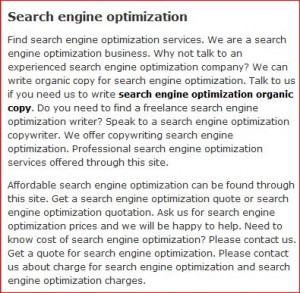
Take a look at this example:

bad seo

Believe it or not, this was taken from an actual SEO Copywriter’s website (not mine!). The term ’search engine optimisation’ appears 17 times in this small section alone. Would you want to do business with someone who writes like that?

Absolutely not.

Keywords do have to be present but not to that degree. It is their location rather than number that’s important.

Using a professional SEO copywriter may not be cheap but they know how to create fantastic copy that will convert and get great rankings.

Your website is your online sales machine so don’t take chances with its effectiveness. If you are really serious about internet marketing and getting the most out of your website, invest in a good SEO Copywriter.

Remember, your customers must always come above the search engine spiders – after all what’s the use of thousands of visitors to your website a day if none of them convert?

Why Your Call to Action Matters


What is the one vital aspect of copy that is often missed?

The call to action.

It’s true that copywriting is about building rapport with your readers—you have to get to know them, understand what makes them tick and befriend them. Perhaps that’s why people shy away from actually telling them what to do.

But if your copy doesn’t shout “Oi! Get in touch and buy now” (OK perhaps a bit harsh) they’ll just swan off and read someone else’s website, brochure, email or letter.

So how do you go about driving your reader towards your call to action?

Start softly

Good copy builds a relationship with the reader. Through your words you must show that you understand what their problems are and that you know how to solve them. Identifying the benefits of the product/service you’re selling will illustrate this. It will show how their lives will be improved by using the product/service—it shows that you care, that you’re willing to listen and take action to make their life better.

Once they’ve read all of that, they’ll be your best friend forever and will do anything you ask.

Stage two

As your reader now trusts you completely it’s time to move onto the next stage in your blossoming relationship.

They now realise that what you’re selling is what they need, they are completely convinced of the fact that it’s what they want. But now they’ve reached the end of the page there’s a problem—you haven’t told them what to do next.

There’s just an empty space.

They don’t know what to do, they go into a blind panic, hit the back browser and head off to another website. All your hard work as gone to waste.

What went wrong?

You’ve forgotten a very important sentence. A sentence that will tell them what they need to do. You have forgotten the call to action.

“But they know they want to buy the product, why should I have to tell them to buy it?”

A very valid point, but as far as your reader is concerned, why should they have to hunt around your website trying to work out what to do next? If you can’t be bothered to tell them to Click here to buy now, or Call us today on 123 456 78 and book your appointment, why should they stick around?

Take a look at your website - do you have a CTA? If the answer’s “no” get one added to every sales page.

Don’t leave your sales conversion rate to chance. If you want your reader to buy, tell them.

Why You Should Always Review Your Writing


Have you ever written something, thought it was the best thing since sliced bread but then, when you’ve gone back to it after a few months or even years later, cringed at how awful it was?

I have.

I used to write a lot as a child and had a little notebook I’d write stories in. I found it a few months back – was I glad I’d never shown them to anyone else!

Today, I may not be the award winning novelist I’d always hoped to be one day, but I am writing for a living as a freelance copywriter. If there’s one thing I’ve learnt since copywriting it’s to always, always review your writing.

The problem with writing is, you become completed absorbed in the process. Once completed, you’re so close to what you’ve written it’s hard to review it objectively. But time changes your perception and that’s when you begin to see the chinks in what you thought was perfect writing.

Being a commercial writer though time is very limited. Deadlines are often very tight so being able to objectively critique your own work can be a challenge.

But I’ve learnt a few tricks along the way—have a read, they might help you too:

1. Leave it

We’ve already touched on this one and know it isn’t always easy to do. When you’re up against tight deadlines you can’t leave work for days or weeks before checking it through.

One way of getting round it is by working on a few projects simultaneously. That way you can complete one draft, leave it for a day or so whilst working on the next, and then go back to it with fresher eyes.

2. A second pair of eyes

Unless you have a very understanding spouse/partner this can prove costly. If you use a proof-reader you can build the associated costs into your quotes. Getting someone who’s not been involved with the original work is the best and most effective way of picking up any errors.

3. Be the reader

Before undertaking the project, you would have taken the time to get to know your client’s business and products before writing. You understand their customers’ needs and the type of people they are to ensure you use the right tone.

But once you’ve written the copy you must then read it like the reader. Review it as if you don’t know the product—does it all make sense? Are there any words or phrases that sound strange? Has any jargon crept in that is clouding the message? There are all things you need to consider to ensure your message is clear.

4. Read out loud

Reading out loud is so important. You might think you can save yourself a bit of embarrassment by reading through your copy in your head. Trust me, it’s much better to read out loud. By doing so you are listening as well as reading; you’ll pick up on any repetitions, sections that don’t flow easily, words that clash causing you to ‘trip over yourself’.

5. Proofread

This is incredibly important. If you are writing commercially (or even writing internal memos, reports or even emails) you must read through your work before publishing or sending.

There is nothing worse than printing out a letter or sending emails only then to find a typo. It looks unprofessional and that’s not an image you want to portray.

Your written communications are often the first impression someone will have of your company so you have to be sure they give the right impression. It might seem like a waste of time or inconvenience to have to read through your work, but it’s worth it.

And we’re not talking about a cursory glance—read every single word; check for typos, grammatical errors and the layout of your text. Make sure it looks right as well as reads right.

How do you review your work? Are there any tips you’d like to share?

Related Posts with Thumbnails